Odoo Functional & Developer Training with Certified Odoo Courses Online
As businesses increasingly adopt ERP systems to streamline operations, the demand for skilled professionals continues to rise. Odoo training has become one of the most valuable learning paths for individuals and teams looking to master ERP workflows, automation, and system customization. Whether you are a beginner exploring ERP concepts or a professional aiming to advance technical expertise, structured Odoo learning opens doors to long-term career growth and operational excellence.
Modern Odoo courses are designed to cover both business and technical perspectives. From functional configuration and process optimization to advanced development and system upgrades, Odoo online training provides flexible, skill-oriented education aligned with real-world ERP use cases.
Why Odoo Training Is Essential in Today’s ERP Landscape
ERP systems impact every business function — finance, sales, inventory, manufacturing, HR, and customer management. Without proper training, organizations struggle to unlock the full value of ERP platforms.
Odoo training helps learners:
- Understand ERP workflows and business logic
- Configure modules efficiently
- Customize applications without system instability
- Manage upgrades and version changes
- Improve productivity and automation outcomes
With structured Odoo learning, professionals gain confidence in managing complex ERP environments while reducing operational errors.
Types of Odoo Training Courses Available
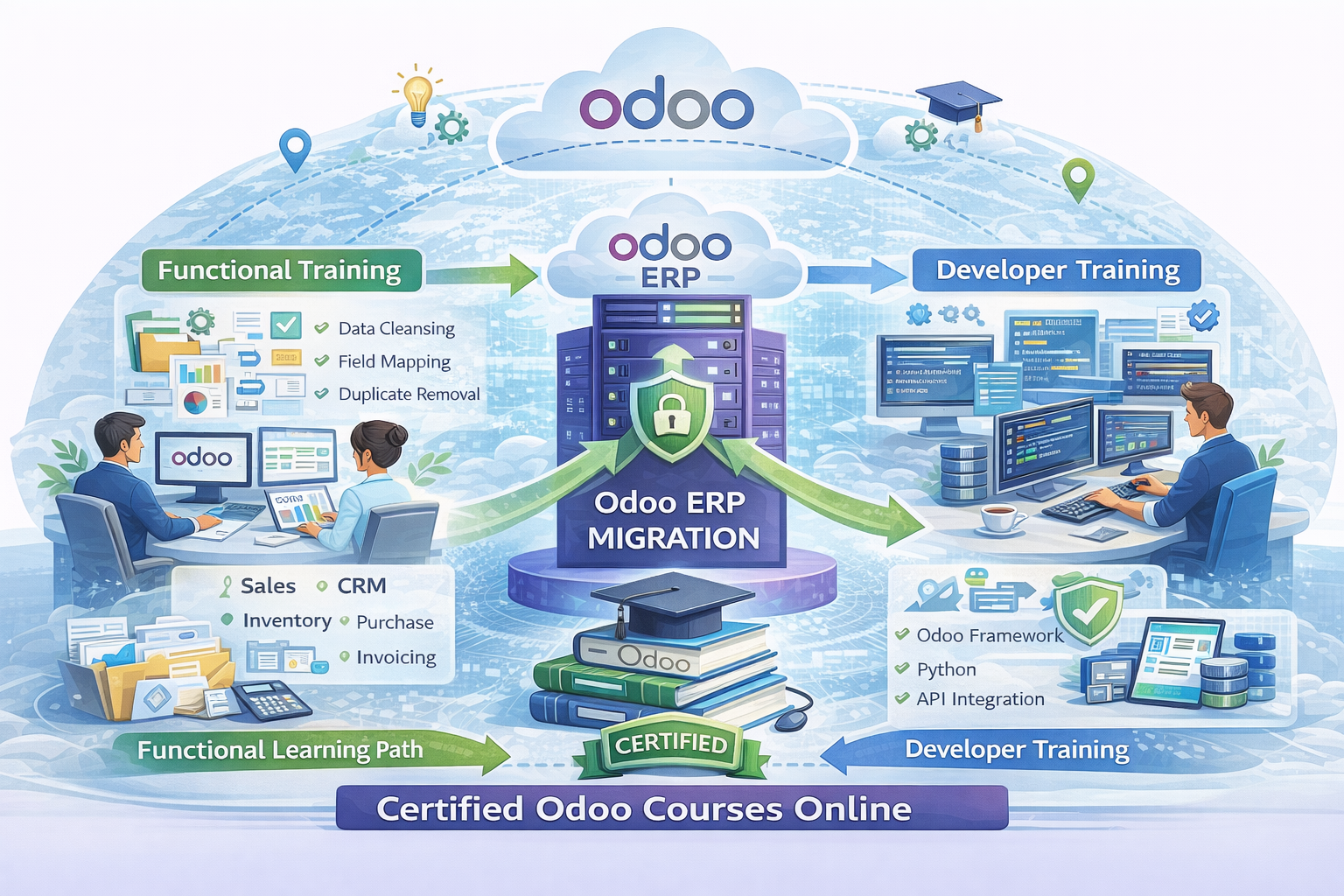
1. Odoo Functional Training
Odoo functional training focuses on business users, consultants, and analysts who configure ERP modules and manage daily operations.
This training covers:
- Sales, CRM, and customer workflows
- Accounting and financial reporting
- Inventory and warehouse management
- Manufacturing and MRP operations
- Purchase and vendor management
- ERP configuration and process optimization
Functional learners gain the ability to translate business requirements into ERP configurations without coding.
2. Odoo Developer Training
Odoo developer training is designed for technical professionals who build, customize, and extend ERP functionality.
Developer training includes:
- Odoo framework architecture
- Python-based module development
- XML views and UI customization
- ORM and database interactions
- API integration techniques
- Performance optimization
- Security and access control
This training prepares developers to build scalable ERP applications aligned with enterprise requirements.
3. Odoo Online Training
Odoo online training provides flexible learning for global audiences through instructor-led sessions, recorded modules, and hands-on labs.
Benefits include:
- Learn from anywhere at your own pace
- Access structured course materials
- Practical assignments and ERP simulations
- Live doubt-clearing sessions
- Suitable for individuals and teams
Online learning enables continuous skill development without geographic or time constraints.
What Makes a High-Quality Odoo Training Course?
Not all training programs deliver real ERP expertise. Effective Odoo training courses follow a structured and practical approach.
Key elements include:
- Real-world ERP use cases
- Step-by-step module configuration
- Practical development exercises
- Version-specific learning paths
- Business scenario mapping
- Upgrade and migration fundamentals
A well-designed Odoo training course prepares learners for real implementation and support scenarios.
Learning Paths for Odoo Functional & Developer Roles
Functional Learning Path
Ideal for ERP consultants, business analysts, and operational teams.
Focus areas:
- Business process understanding
- ERP configuration best practices
- Cross-module workflow management
- Reporting and dashboards
- ERP optimization techniques
Developer Learning Path
Suitable for programmers and technical architects.
Focus areas:
- Custom module development
- ERP extension and customization
- API integration
- Debugging and performance tuning
- Version compatibility handling
Both paths can be combined to create full-stack ERP expertise.
Role of Odoo Training in ERP Upgrades
ERP systems evolve continuously. Without structured knowledge, upgrades can break workflows and customizations.
Odoo upgrade-focused training helps learners:
- Understand version changes
- Adapt custom modules
- Maintain data integrity
- Validate system compatibility
- Ensure smooth post-upgrade performance
Professionals trained in Odoo learning best practices handle upgrades with minimal risk and downtime.
Who Should Enroll in Odoo Training Courses?
- ERP beginners exploring business systems
- Functional consultants seeking specialization
- Developers entering ERP development
- Professionals handling ERP upgrades
- Businesses training internal teams
- Support teams managing ERP operations
- Freelancers expanding service offerings
Structured Odoo training benefits both individuals and organizations aiming for ERP excellence.
Benefits of Certified Odoo Online Training
- Industry-relevant ERP expertise
- Practical, job-ready skills
- Improved implementation accuracy
- Faster ERP adoption
- Reduced dependency on external resources
- Career growth opportunities
- Better upgrade and support handling
Certification-oriented learning validates professional expertise and enhances credibility.
How Odoo Training Is Structured
Understanding core concepts and module relationships.Focused learning based on role objectives.Real ERP environment exercises.Customization, integrations, and performance optimization.Handling version changes and system continuity.Skill validation through evaluations and projects.
Conclusion
Odoo ERP skills are no longer optional in modern business environments. Structured Odoo training empowers professionals to configure, customize, and manage ERP systems efficiently. Whether through Odoo functional training, Odoo developer training, or flexible Odoo online training, learners gain practical expertise aligned with real-world ERP demands. With the right Odoo learning path, individuals and organizations achieve stronger ERP adoption, smoother upgrades, and long-term operational success in global business environments.